
Validation/Plasticity
A bar pulled past yield
One load level sits below yield as a control. It is not decoration: a deck with the yield stress missing gets that level exactly right and the others badly wrong.
Why this case
A steel bar one metre long in uniaxial tension, at three stress levels either side of its yield stress. The material is linear-elastic to 250 MPa and linear again beyond it at a tenth of the elastic modulus.
The closed form is two lines and both are exact:
- ε = σ/E while σ ≤ Sᵧ
- ε = Sᵧ/E + (σ − Sᵧ)/Eₜ beyond it
That is precisely what the constitutive model in the deck integrates, so nothing in the reference is linearised or approximated. Von Mises equivalent stress equals the axial stress in uniaxial tension, so the three-dimensional law reduces to those two lines with nothing dropped.
| Physics | Nonlinear static, von Mises plasticity with linear isotropic hardening |
|---|---|
| Material | E = 210 GPa, ν = 0.3, yield 250 MPa, tangent modulus 21 GPa |
| Applied | 150, 300 and 400 MPa of axial tension |
| Closed form | Elastic to yield, linear hardening beyond it |
| Mesh | Tetrahedral, from Netgen — 516 elements |
| Agreement | Elongation within 0.000 % at all three levels |
| Last run | 2026-08-27 |
Result
| Applied stress | State | Closed form | Measured | Difference | Von Mises |
|---|---|---|---|---|---|
| 150 MPa | Elastic | 0.714286 mm | 0.714286 mm | +0.00004 % | 150.0000 MPa |
| 300 MPa | Plastic | 3.571429 mm | 3.571430 mm | +0.00004 % | 300.0000 MPa |
| 400 MPa | Plastic | 8.333333 mm | 8.333330 mm | −0.00004 % | 400.0000 MPa |
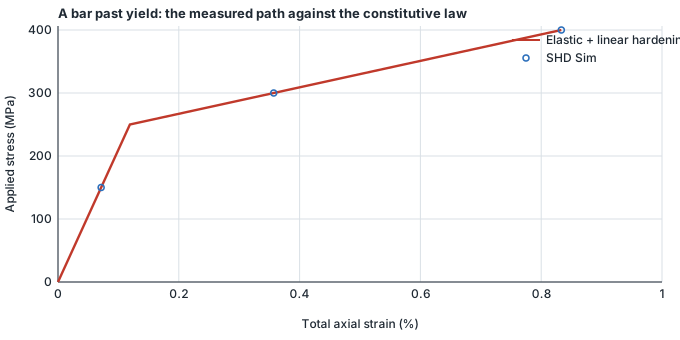
At the top level the plastic term is six times the elastic one, so that answer is governed by the hardening slope and hardly at all by the elastic modulus.
Why one of the three levels is below yield
The 150 MPa case is a control. It has to come back at σ/E, which is what shows the plastic branch is not being entered when it should not be.
The restraint, and why it is not a clamp
The base face is held only in the axial direction, and two further faces sit on symmetry planes. That makes the model one quadrant of a bar four times the area, and the stress state is then exactly uniaxial everywhere.
Building the base in — holding all three directions on that face, which is the restraint everybody reaches for — prevents the material contracting sideways there. That puts a three-dimensional stress state in the end region, and the closed form stops describing the problem anywhere near it.
Repeat this yourself
Every case here is set up from the worked examples in the product, with no hand-editing of solver files — so you can run it, and get the same numbers. The free tier runs real cases up to 250,000 cells of fluids, or 100,000 nodes of solid, with no account needed to download and no time limit.
Other cases
- Cantilever beamThe first published-reference case for the structural backend — and the one that found the peak stress at a re-entrant corner does not converge at all, which is why this page validates a deflection and says plainly why it does not validate a stress.
- Plate with a holeThe stress concentration factor of three, and a four-mesh study separating a coarse mesh from a finite plate — two explanations one run could not tell apart.
All validation cases · Written by the team building SHD Sim.