
Validation/Structural mechanics
Cantilever beam
The first published-reference case for the structural backend — and the one that found the peak stress at a re-entrant corner does not converge at all, which is why this page validates a deflection and says plainly why it does not validate a stress.
Why this case
A cantilever under a distributed load is the textbook problem every strength-of-materials course opens with: fix one end, load the beam along its length, and elementary theory gives the tip deflection in closed form. Like the shock tube and the plate with a hole, the reference is an equation this project can solve itself, not a measurement with its own uncertainty to argue about.
It is also the first published-reference case for the structural (code_aster) backend: seven analysis types ship, and until this page had a comparison behind none of them.
| Physics | Linear elastic, small strain, static |
|---|---|
| Solver | code_aster, MECA_STATIQUE, tetrahedral quadratic (TET10) |
| Reference | Euler-Bernoulli beam theory; Timoshenko & Goodier, Theory of Elasticity |
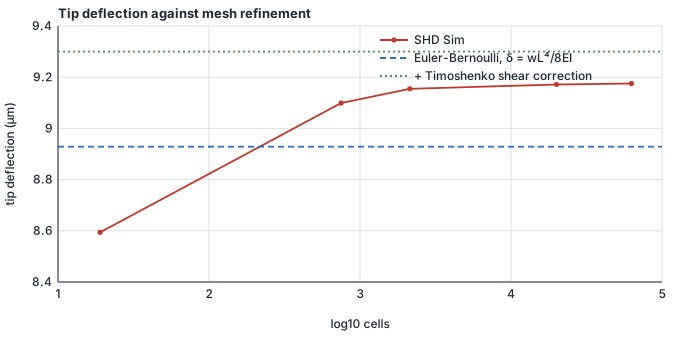
| Agreement | Deflection converges to +2.76 % of Euler-Bernoulli, −1.34 % once shear is added |
| Reproduce | Import the bar → Structural → Linear static → Netgen mesh → Run |
The problem
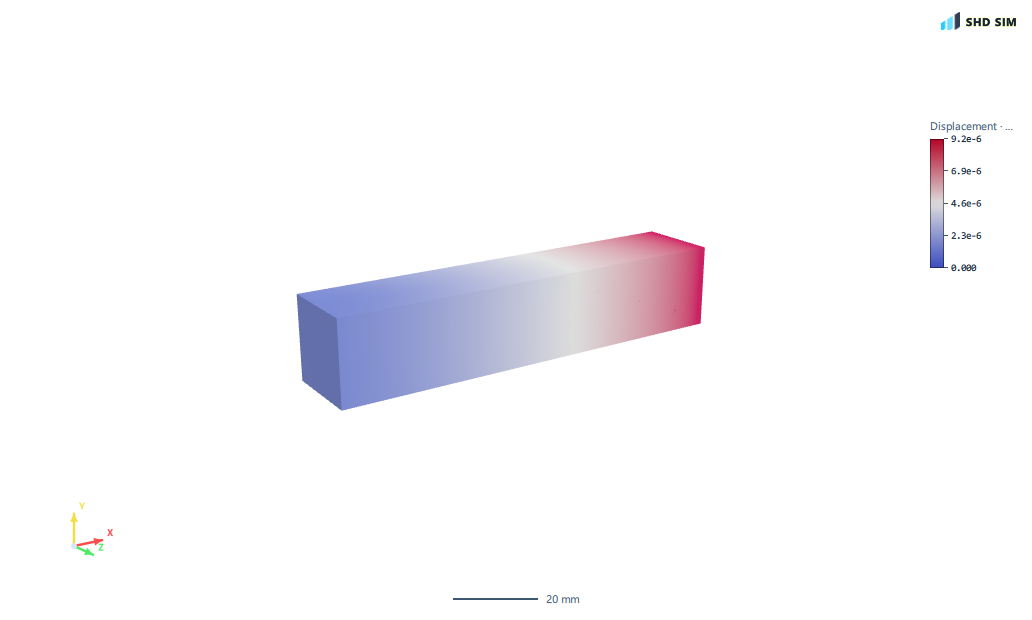
A steel bar, one end clamped, a uniform pressure on the top face bending it downward — the standard idealisation of a cantilever under a distributed load.
Geometry
  clamped                                    p = 1e5 Pa
    ┃█████████████████████████████████████│  ↓↓↓↓↓↓↓↓↓↓
    ┃                                       ▔▔▔▔▔▔▔▔▔▔▔▔
    ┃─────────────── L = 0.1 m ────────────▶
  x = 0                                  free tip

  cross-section 0.02 m × 0.02 m (y, z), L/h = 5
Steel: E = 210 GPa, ν = 0.3. The load is a uniform pressure of 1×10⁵ Pa on the top face, which over the 0.1 m span is a distributed load w = pressure × width = 2000 N/m.
The exact solution
For a uniformly distributed load on a cantilever, elementary beam theory gives
delta = w L^4 / (8 E I), I = b h^3 / 12
which for w = 2000 N/m, L = 0.1 m, E = 210 GPa and I = 1.3333×10⁻⁸ m⁴ gives δ = 8.9286×10⁻⁶ m.
Results
| Mesh | Tets | SHD Sim δ (m) | vs Euler-Bernoulli | vs Timoshenko |
|---|---|---|---|---|
| Default | 19 | 8.5941 × 10⁻⁶ | −3.75 % | −7.59 % |
| maxh 0.008 | 749 | 9.0991 × 10⁻⁶ | +1.91 % | −2.16 % |
| maxh 0.004 | 2 136 | 9.1546 × 10⁻⁶ | +2.53 % | −1.56 % |
| maxh 0.002 | 20 001 | 9.1715 × 10⁻⁶ | +2.72 % | −1.38 % |
| maxh 0.0015 | 62 797 | 9.1754 × 10⁻⁶ | +2.76 % | −1.34 % |
The finest mesh sits +2.76 % above the theory that ignores shear and −1.34 % against the theory that includes it — closer to the more complete physics, which is the expected direction: a finite-element solution has no reason to reproduce a simplification’s own error.
What the stress does not show
The same five meshes, read for peak von Mises stress instead of deflection:
| Mesh | SHD Sim peak von Mises (Pa) | Euler-Bernoulli σ at the root (Pa) |
|---|---|---|
| Default | 5.31 × 10⁶ | 7.50 × 10⁶ |
| maxh 0.008 | 6.95 × 10⁶ | 7.50 × 10⁶ |
| maxh 0.004 | 8.30 × 10⁶ | 7.50 × 10⁶ |
| maxh 0.002 | 1.107 × 10⁷ | 7.50 × 10⁶ |
| maxh 0.0015 | 1.217 × 10⁷ | 7.50 × 10⁶ |
What this case settles
Before this study, the only number connected to this set-up was a peak displacement sitting in the application’s own end-to-end test suite since the structural module shipped, with nothing to check it against. This page is what checks it: on the same coarse default mesh the closed form is 3.75 % away, squarely inside what a 19-element mesh should cost a bending problem, and refinement carries the answer to within a per cent and a half of the more complete shear-corrected theory.
It also settles what this set-up cannot answer: a stress read at a re-entrant corner, which is a statement about the idealisation, not about the solver.
Reproducing this
- Import a long, thin bar; choose Structural → Linear static, backend code_aster
- Material: Steel (mild) from the catalogue
- Restraints: fix all three translations on the clamped end face
- Loads: a Pressure load of 1×10⁵ Pa on the top face
- Mesh with Netgen — the comparison above used the default sizing and three levels of refinement
- Solve; peak displacement and peak von Mises are read from the Results pane
Repeat this yourself
Every case here is set up from the worked examples in the product, with no hand-editing of solver files — so you can run it, and get the same numbers. The free tier runs real cases up to 250,000 cells of fluids, or 100,000 nodes of solid, with no account needed to download and no time limit.
Other cases
- Plate with a holeThe stress concentration factor of three, and a four-mesh study separating a coarse mesh from a finite plate — two explanations one run could not tell apart.
- Sod shock tubeThe exact Riemann solution, compared point by point. It found a defect nobody had noticed: the solver was using the wrong ratio of specific heats.
All validation cases · Written by the team building SHD Sim.