
Validation/Structural dynamics
Cantilever natural frequency
The modal companion to the cantilever deflection case: same beam, same closed form, a different analysis type.
Why this case
The same rectangular steel bar and the same clamped end as the cantilever deflection case — no load, solved for its own natural frequencies instead.
Running the same geometry through a different analysis type is the point. Anything wrong with the material, the restraint or the mesh would show up in both; anything that shows up in only one of them is in the analysis path, which is a much smaller place to look.
| Physics | Modal, linear elastic, unloaded |
|---|---|
| Geometry | Rectangular steel bar, one end clamped |
| Reference | Euler–Bernoulli beam theory — a closed-form elastic solution |
| Mesh | Tetrahedral, four levels from 19 to 20 001 elements |
| Agreement | First mode −2.13 % against Euler–Bernoulli; +0.21 % against Timoshenko |
| Last run | 2026-08-19 |
Result
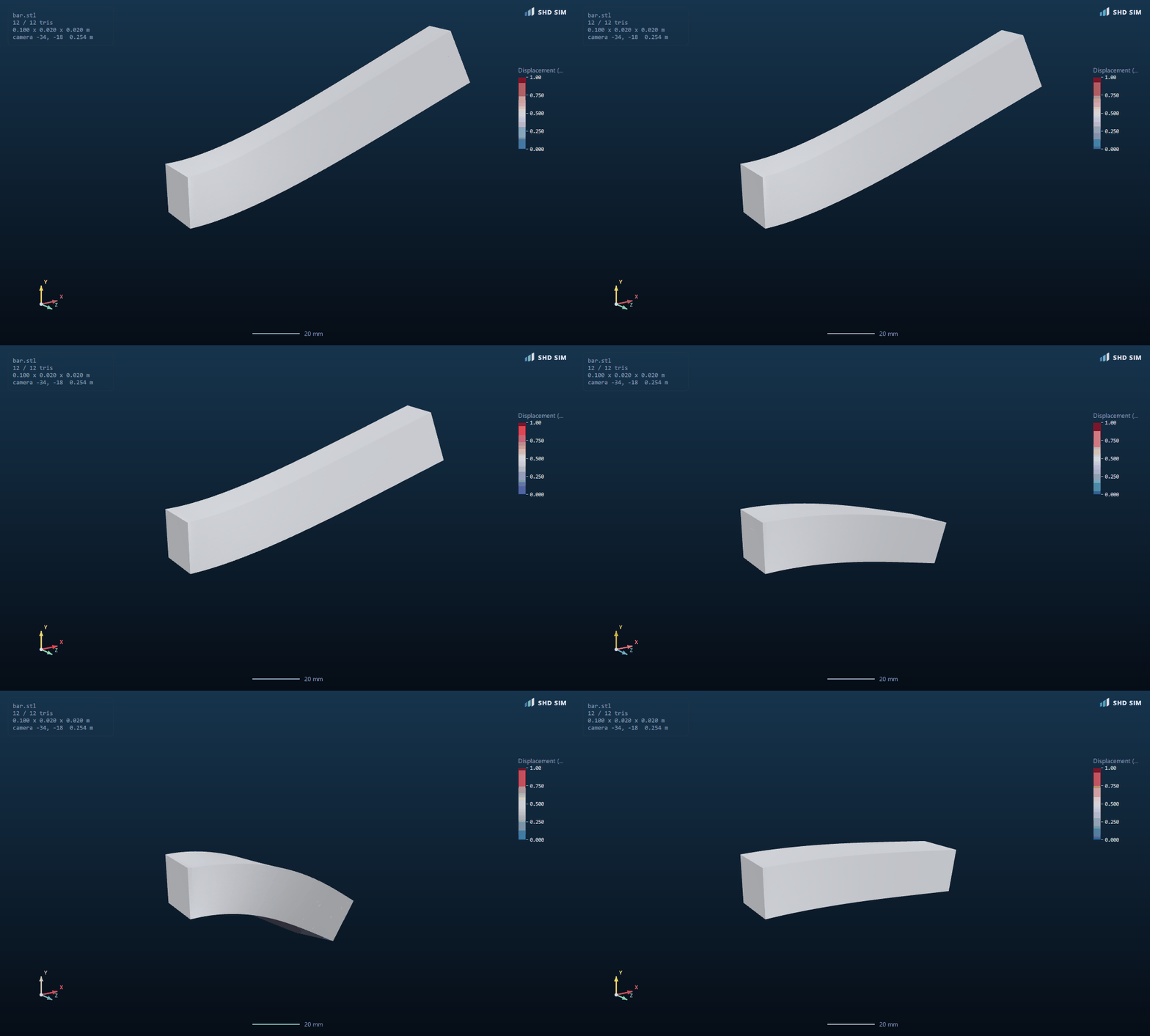
| Mesh | Nodes | Tets | f₁ (Hz) | vs Euler–Bernoulli | f₂ (Hz) |
|---|---|---|---|---|---|
| Default | 64 | 19 | 1692.82 | +1.30 % | 1697.10 |
| maxh 0.008 | 1 306 | 749 | 1642.10 | −1.73 % | 1642.61 |
| maxh 0.004 | 4 162 | 2 136 | 1636.97 | −2.04 % | 1637.05 |
| maxh 0.002 | 31 940 | 20 001 | 1635.52 | −2.13 % | 1635.55 |
Every mesh degenerates the first two modes correctly. f₁ and f₂ agree to 0.25 % at the coarsest mesh and to 0.002 % at the finest — the square cross-section’s two orthogonal bending modes, as theory requires. A solver whose stiffness or mass matrix had an axis wired wrong would not produce this, and it is a check the frequency alone does not give you.
What the remaining difference is
The deflection case’s residual converged to zero as the mesh refined. This one converges to about −2.1 % and stops there. That is not an unconverged run — the last refinement, 4 162 to 31 940 nodes, moved the answer by 0.09 percentage points — it is a real gap between the finite-element answer and pure Euler–Bernoulli theory.
Euler–Bernoulli ignores shear deformation. The standard first-order Timoshenko correction for a cantilever’s fundamental frequency, evaluated for this geometry, gives 1632.09 Hz. The converged answer of 1635.52 Hz sits +0.21 % above that and −2.13 % below the uncorrected prediction — so the correction accounts for essentially all of the residual.
Repeat this yourself
Every case here is set up from the worked examples in the product, with no hand-editing of solver files — so you can run it, and get the same numbers. The free tier runs real cases up to 250,000 cells of fluids, or 100,000 nodes of solid, with no account needed to download and no time limit.
Other cases
- Cantilever beamThe first published-reference case for the structural backend — and the one that found the peak stress at a re-entrant corner does not converge at all, which is why this page validates a deflection and says plainly why it does not validate a stress.
- Duct resonanceA closed form for the resonant frequency, and a mesh sweep that converges onto it monotonically.
All validation cases · Written by the team building SHD Sim.