
Validation/Magnetostatics
Straight conductor, against Ampère
Ampère’s law is exact and the geometry is trivial, which is what makes the residual difference worth reporting rather than explaining away.
Why this case
A straight, non-magnetic conductor carrying a uniform current, sampled at a radial distance well clear of its own cross-section and well inside its own length. The reference is Ampère’s law in its infinite-straight-wire form, B(r) = μ₀I / 2πr — a closed-form field, not an experiment.
Unlike the parallel-plate capacitor, which agreed with its closed form at every mesh with nothing to explain, this one only converges cleanly once two separate real problems are worked around. Both are recorded here rather than smoothed over.
| Physics | Magnetostatic, edge-element solve |
|---|---|
| Closed form | B(r) = μ₀I / 2πr |
| Sampling window | r = 0.03 to 0.07 m, clear of the conductor and inside its length |
| Mesh | Four independent levels, 132 186 to 176 237 nodes, conductor plus air region |
| Agreement | Spans 0.99–8.18 % across the sweep; 1–4 % at the largest radius |
| Last run | 2026-08-19 |
Result
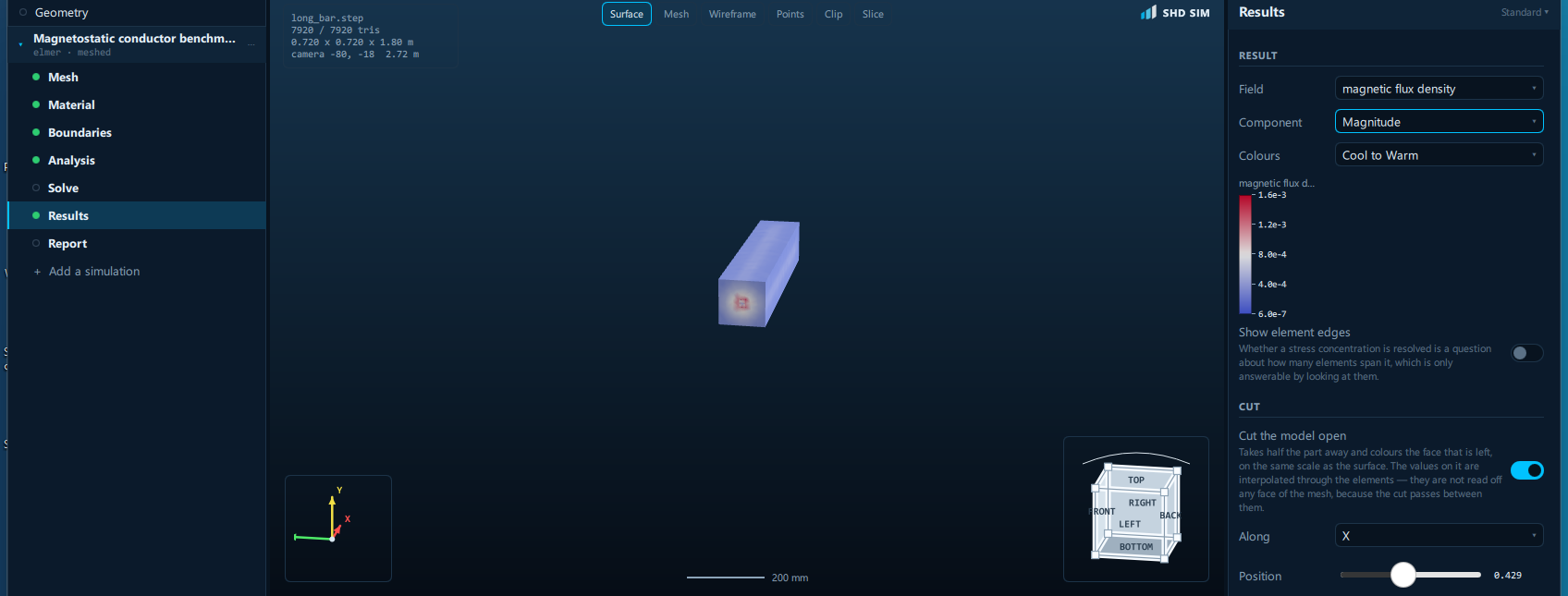
| maxh | Nodes | r ≈ 0.03 m | r ≈ 0.05 m | r ≈ 0.07 m |
|---|---|---|---|---|
| 0.012 | 132 186 | 0.918 | 0.965 | 0.969 |
| 0.008 | 135 244 | 0.956 | 0.955 | 0.990 |
| 0.005 | 139 263 | 0.947 | 0.969 | 0.989 |
| 0.003 | 176 237 | 0.930 | 0.976 | 0.962 |
What this case exercises
Magnetostatics had an end-to-end test and a deck smoke test, but no published reference — nothing had ever checked whether the numbers it produces are right, only that it runs and matches its own prior output.
- The air-region meshing path, unique to magnetostatic and eddy-current analyses: the field does not stop at the part’s surface, so the surrounding air has to be in the mesh too, built by subtracting the part from a padded box and gluing the two regions together.
- The edge-element solve path — the only analysis in the product whose unknown lives on mesh edges rather than nodes, and the only one meshed at first order rather than the usual second, because the solver refuses a quadratic mesh for it.
Repeat this yourself
Every case here is set up from the worked examples in the product, with no hand-editing of solver files — so you can run it, and get the same numbers. The free tier runs real cases up to 250,000 cells of fluids, or 100,000 nodes of solid, with no account needed to download and no time limit.
All validation cases · Written by the team building SHD Sim.