
Validation/Electrostatics
Parallel-plate capacitor
A closed form with no experimental uncertainty in it, so the agreement is either exact or it is a defect.
Why this case
A rectangular PTFE bar with two opposite end faces held at 5 V and 0 V — a parallel-plate capacitor with the dielectric filling the whole gap.
It is the electrostatics equivalent of the lid-driven cavity: the first thing any field solver is checked against, because the field between two infinite equipotential planes is exact and elementary. Uniform, normal to the plates, magnitude E = V/d.
Two things are measured, and the second one is the one that matters. The field is checked against V/d, which is what this page originally led with. The capacitance is checked against C = ε₀ε_r A/d — and as the section below sets out, that is the only one of the two that can tell whether the dielectric was entered correctly at all.
| Physics | Electrostatic, solid dielectric |
|---|---|
| Applied | 5 V and 0 V on opposite end faces, 0.1 m apart |
| Closed form | E = V/d = 50 V/m exactly, and C = ε₀ε_r A/d = 7.437517762752 × 10⁻¹⁴ F |
| Mesh | Tetrahedral, from Netgen — four levels from 19 to 20 001 elements |
| Agreement | Field within 4 × 10⁻⁷ %; capacitance to thirteen significant figures |
| Last run | 2026-08-28 |
Result — electric field
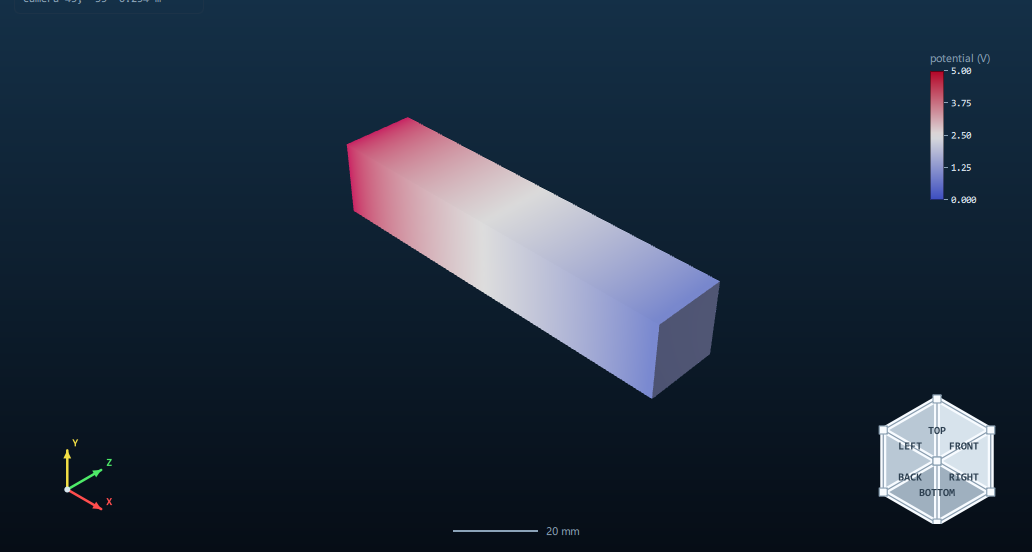
| Mesh | Nodes | Tets | Measured E_x (V/m) | vs closed form |
|---|---|---|---|---|
| Default | 64 | 19 | 50.000000 | +1.6 × 10⁻⁷ % |
| maxh 0.008 | 1 306 | 749 | 50.000011 | +2.3 × 10⁻⁵ % |
| maxh 0.004 | 4 162 | 2 136 | 49.999999 | −2.5 × 10⁻⁶ % |
| maxh 0.002 | 31 940 | 20 001 | 50.000000 | −4.0 × 10⁻⁷ % |
Result — capacitance, and why the field alone proves nothing
The field cannot fail. Laplace’s equation with a uniform permittivity has the same solution for every permittivity — the material divides out — so the potential between the plates does not depend on the dielectric in any way. E = V/d is what the solver returns whatever number is in the material card, including a number that is nonsense.
This is not a hypothetical. The trap this deck names in the section below — an absolute permittivity, 1.85938 × 10⁻¹¹ F/m, typed into a field that wants the ratio 2.1 — was run deliberately. Its field column comes back identical to the correct run’s, digit for digit, on three of the four meshes, and agrees to seven significant figures on the fourth. Every number in the table above would have been reproduced exactly by a deck whose dielectric was wrong by eleven orders of magnitude. The field agreement alone would not have caught it.
What does catch it is the capacitance. StatElecSolve integrates the stored energy ½∫εE·E over the body and prints its own capacitance, so this is the one quantity measured here that carries the permittivity through to the answer.
| Mesh | Tets | Measured C (F) | Closed form (F) |
|---|---|---|---|
| Default | 19 | 7.437517762752 × 10⁻¹⁴ | 7.437517762752 × 10⁻¹⁴ |
| maxh 0.008 | 749 | 7.437517762761 × 10⁻¹⁴ | 7.437517762752 × 10⁻¹⁴ |
| maxh 0.004 | 2 136 | 7.437517762754 × 10⁻¹⁴ | 7.437517762752 × 10⁻¹⁴ |
| maxh 0.002 | 20 001 | 7.437517762758 × 10⁻¹⁴ | 7.437517762752 × 10⁻¹⁴ |
The wrong-permittivity deck lands at 6.5853198941 × 10⁻²⁵ F against the same closed form, low by a factor of about 1.1 × 10¹¹. That is the gap between a check that sees the material and a check that cannot.
What this case checks
Nothing in the electromagnetics family had a published number behind it before this case. It is the simplest of the four analysis types, which is what makes it useful: what it exercises is the translation layer itself.
- The boundary-condition path — two potential conditions, on two different named groups, at two different values. The same mechanism every EM case uses to hold a face at a voltage.
- The material path — relative permittivity written alongside the permittivity of vacuum as an explicit constant. The trap this deck exists to avoid is an absolute permittivity being typed into a field that wants a ratio — which, as above, is caught by the capacitance and by nothing else on this page.
- The result path — the field and the energy, read back from the
.vtuthe solver writes.
Repeat this yourself
Every case here is set up from the worked examples in the product, with no hand-editing of solver files — so you can run it, and get the same numbers. The free tier runs real cases up to 250,000 cells of fluids, or 100,000 nodes of solid, with no account needed to download and no time limit.
Other cases
- Straight conductor, against AmpèreAmpère’s law is exact and the geometry is trivial, which is what makes the residual difference worth reporting rather than explaining away.
- Plate with a holeThe stress concentration factor of three, and a four-mesh study separating a coarse mesh from a finite plate — two explanations one run could not tell apart.
All validation cases · Written by the team building SHD Sim.