
Validation/Structural dynamics
Cantilever step response
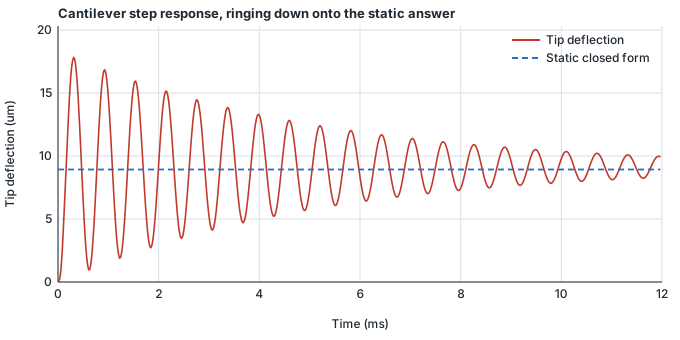
It rings at 1634.5 Hz where the frequency-domain sweep on the same bar puts the resonance at 1637.6 — two different solvers agreeing to 0.19 % about a number neither was given.
Why this case
The same steel cantilever again, with the same distributed load — but applied as a step at t = 0 and held, then integrated in time for twenty periods of the first mode.
Three quantities, and the third is the one that cannot be faked:
- The settled value. Once the ringing has decayed the answer is the static one, exactly.
- The ringing frequency, against the Euler–Bernoulli eigenvalue.
- The logarithmic decrement — how fast the ringing dies away.
| Physics | Transient dynamic, Newmark integration with Rayleigh damping |
|---|---|
| Material | Steel — E = 210 GPa, ν = 0.3, ρ = 7 850 kg/m³ |
| Applied | 10⁵ Pa stepped on at t = 0; damping ratio 0.02 at f₁ |
| Time | 20 periods in 800 steps — 40 steps per period |
| Closed form | Euler–Bernoulli beam theory, and δ = 2πζ/√(1−ζ²) |
| Mesh | Tetrahedral, from Netgen — 713 elements |
| Agreement | Logarithmic decrement within 0.926 % |
| Last run | 2026-08-27 |
Result
| Quantity | Closed form | Measured | Difference |
|---|---|---|---|
| Settled value | 8.928571 × 10⁻⁶ m | 9.118779 × 10⁻⁶ m | +2.130 % |
| Ringing frequency | 1 671.033 Hz | 1 634.476 Hz | −2.188 % |
| Logarithmic decrement | 0.122938 | 0.121799 | −0.926 % |
| First overshoot | — (reported, not judged) | 1.9527 × the settled value | — |
Why the decrement is the measurement
A step response settles to the static answer whatever the damping is, and it rings at very nearly the undamped natural frequency for any small damping. So the first two quantities say nothing at all about the damping matrix.
The logarithmic decrement does, and like the frequency-domain case’s amplification it is a ratio of successive peaks on the same mesh, so the discretisation cancels. It lands at 0.926 % where the absolute deflection is 2.13 %.
Why the overshoot is reported and not judged
A step load excites every mode, and the familiar “twice the static deflection” is a single-degree-of-freedom result. The real first peak is twice the first mode’s share of the static deflection plus whatever the higher modes happen to be doing at that instant — which depends on the time step through the integration as much as on the physics.
It is worth printing, because a number near 2 is a good sign and a number near 1 would mean the load had been applied as a ramp rather than a step. It is not worth a tight tolerance, and this page does not give it one.
Repeat this yourself
Every case here is set up from the worked examples in the product, with no hand-editing of solver files — so you can run it, and get the same numbers. The free tier runs real cases up to 250,000 cells of fluids, or 100,000 nodes of solid, with no account needed to download and no time limit.
Other cases
- Cantilever frequency responseThe amplification at resonance is a ratio of two responses on one mesh, so the discretisation error cancels out of it. It is also the only quantity here that depends on the damping at all.
- Cantilever natural frequencyThe modal companion to the cantilever deflection case: same beam, same closed form, a different analysis type.
All validation cases · Written by the team building SHD Sim.